ARTICLE | 6 Min
EmpCo Regulation 2026: from greenwashing to product evidence
September 24, 2026
In this article
This 27 September 2026, the national measures transposing Directive (EU) 2024/825, Empowering Consumers for the Green Transition, EmpCo, begin to apply. The Directive strengthens consumer protection against greenwashing, early obsolescence practices and certain sustainability-related communications, while also introducing new information requirements on aspects such as durability and repairability.
The scope of the EmpCo Regulation goes beyond the terminology used in marketing. The central issue is the alignment between the actual characteristics of a product, the information available to substantiate them and the way those characteristics are communicated to consumers. This shift is particularly relevant at a time when the European Union is developing new mechanisms to structure product information, including the Digital Product Passport.
What actually changes under the EmpCo Regulation?
EmpCo expressly includes environmental and social characteristics, as well as certain circularity aspects, such as durability, repairability and recyclability, among the main product characteristics in relation to which a commercial practice may be misleading. This brings these issues much more explicitly within the scope of EU rules on unfair commercial practices.
One of the areas receiving particular attention is generic environmental claims. The Directive prohibits such claims where the trader cannot demonstrate recognised excellent environmental performance that is relevant to the claim being made. In addition, for an environmental claim not to be considered generic in this context, its specification must be presented in clear and prominent terms on the same medium.
EmpCo also prohibits environmental claims relating to the entirety of a product or to a company’s overall activity when, in reality, the claim only concerns a specific aspect of the product or a particular activity.
The scope of the communication must therefore correspond to the actual scope of the characteristic being communicated.
Prohibits certain product-level claims of neutral, reduced or positive greenhouse gas impact where based on emissions offsetting.
Restricts sustainability labels not based on a certification scheme or established by public authorities.
Sets conditions for claims relating to future environmental performance.
Introduces pre-contractual information requirements on repairability, software update periods and commercial guarantees of durability.
Overall, EmpCo raises the level of precision required when environmental or circularity-related characteristics are communicated to consumers.
From greenwashing to product evidence
The impact of EmpCo goes beyond the final message presented to the market. In order to determine what can be claimed about a product, companies need to understand precisely what information they hold, where it comes from, which product or attribute it applies to and what that information can actually substantiate.
This introduces a clear product information governance dimension. Data traceability, validity and scope become increasingly important, as technically correct information may still result in problematic communication if it is used out of context or extended beyond what it actually supports.
Compliance with the EmpCo Regulation therefore requires closer coordination between the functions that generate, validate and use product information. Sustainability, Product, Legal, Compliance, Marketing and Ecommerce teams increasingly need to work from a consistent base of data and supporting evidence.
This is where the Digital Product Passport becomes particularly relevant.
EmpCo Regulation and Digital Product Passport: two complementary frameworks
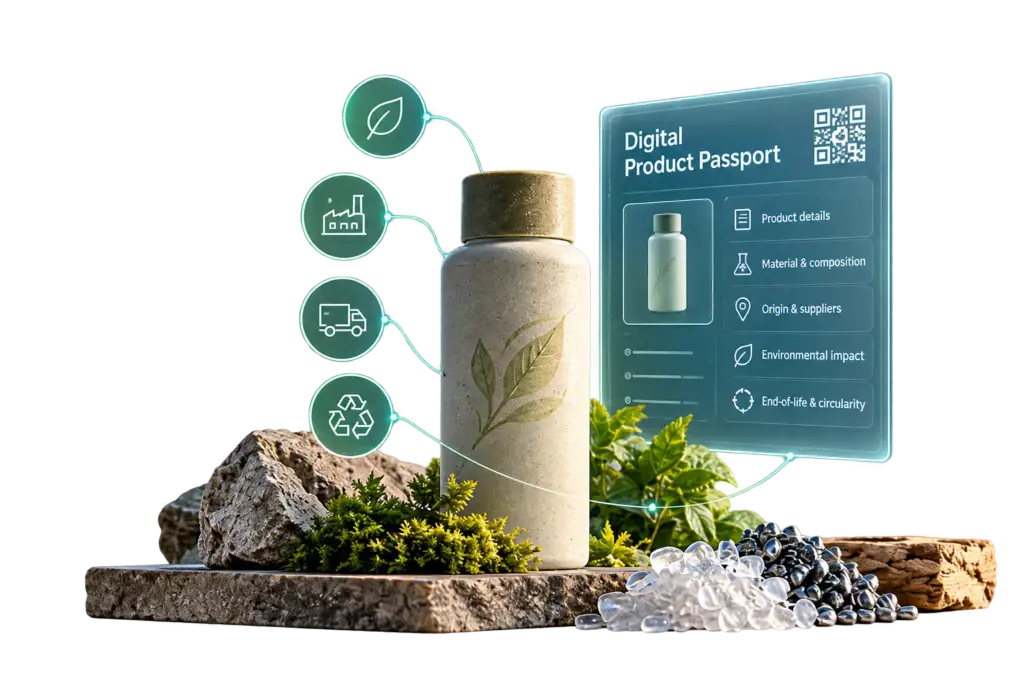
EmpCo and the Digital Product Passport (DPP) belong to different regulatory frameworks. EmpCo does not require the use of a DPP to substantiate a claim, and having a Digital Product Passport does not, in itself, demonstrate compliance with consumer protection rules.
The DPP is established under Regulation (EU) 2024/1781, the Ecodesign for Sustainable Products Regulation — ESPR. The specific information included in a passport will depend on the relevant product group and the applicable delegated acts. The ESPR framework covers product parameters relating, among other things, to durability, repairability, recycled content, recyclability, environmental and carbon footprints, maintenance and the availability of information relevant to repair.
This is precisely where the two frameworks begin to converge. Several product characteristics whose communication becomes particularly relevant under EmpCo are also part of the information framework being developed through the ESPR.
Recognised by the Commission — In the impact assessment accompanying the EmpCo proposal, the Commission noted that repairability information could be included in the Digital Product Passport and described horizontal consumer information rules and product-specific requirements as "fully complementary" in this area.
How the main EmpCo changes connect with the Digital Product Passport
The table below does not imply that the DPP is required to fulfil each EmpCo obligation. Its purpose is to show where the product information infrastructure created under the ESPR can help improve the quality, granularity and traceability of the information behind consumer-facing communications, always subject to the requirements established for each product group.
| EmpCo change or requirement | Role of the Digital Product Passport |
|---|---|
| Environmental and social characteristics and circularity aspects — such as durability, repairability and recyclability — become expressly relevant when assessing whether a commercial practice may be misleading. | The ESPR framework can structure product-specific information on durability, repairability, recycled content, recyclability and environmental impacts where required by the rules for each product group. |
| Generic environmental claims are restricted where recognised excellent environmental performance relevant to the claim cannot be demonstrated. | The DPP can facilitate access to more specific and traceable product information. However, it does not make a generic claim compliant with EmpCo by itself. |
| An environmental characteristic cannot be presented as applying to the whole product or the entire company's activity where it only relates to a specific aspect. | Structured product data can help preserve the correct scope of each attribute and distinguish information relating to a product, material or component where the applicable DPP requirements provide that level of detail. |
| Certain carbon-neutral, climate-neutral or similar claims based on greenhouse gas offsetting are prohibited. | The ESPR allows product information requirements to address carbon and environmental footprints, but having that data in a DPP does not override a prohibition established by EmpCo. |
| Sustainability labels must comply with EmpCo requirements, including being based on a certification scheme or established by a public authority. | A DPP does not validate a sustainability label. The legal conditions applicable to the label remain separate from the information available through the passport. |
| A legal requirement applicable to all products in a category cannot be presented as a distinctive advantage of a specific offer. | Structured information can help identify and evidence compliance with product requirements, but compliance data cannot automatically be transformed into a marketing advantage. |
| EmpCo introduces rules concerning spare parts, repair information, consumables and accessories. | The ESPR framework includes repair, maintenance, spare-parts availability and the characteristics and availability of consumables among the areas that product information requirements may address. |
The value of looking at both frameworks together does not lie in one solving the other, but in the fact that both increasingly depend on the same product reality and on the quality of the data used to describe it.
The Digital Product Passport does not replace EmpCo requirements
This complementarity does not turn the DPP into an automatic compliance mechanism for EmpCo. If a commercial practice is prohibited under the Directive, providing additional information through a Digital Product Passport does not change that prohibition.
The same principle applies to generic environmental claims. Where the legislation requires the information specifying a claim to appear clearly and prominently on the same medium, companies should not assume that directing consumers to additional information through a QR code is sufficient.
The strategic value of the DPP lies in helping companies build structured, granular and traceable product information that can be used consistently across regulatory compliance, product management and consumer communication.
A new approach to product information govrenance
EmpCo marks an important shift in the way sustainability communication is understood. The focus is no longer only on the message itself, but also on the ability to support it with sufficiently precise and reliable information.
This raises a strategic question for companies: preparing for EmpCo should not end with reviewing existing claims. It should also be an opportunity to assess whether the organisation has the information needed to consistently support what it communicates about its products.
In this context, the Digital Product Passport can take on a value that goes beyond its specific regulatory function. Its relevance lies in being part of an information ecosystem in which product data can be reused consistently for different regulatory and commercial purposes.
The opportunity is to move towards sustainability communication that is more specific, transparent and closely connected to the actual characteristics of each product. In this new environment, high-quality information does more than support regulatory compliance: it also enables companies to communicate sustainability progress with greater clarity, credibility and consumer trust.
Related articles

February 2, 2026
Ecodesign Regulation for Sustainable Products (ESPR): what it requires and how to prepare for 2026
An overview of the ESPR Regulation, its requirements, implementation timeline and what companies need to prepare for 2026.

January 20, 2026
The Digital Product Passport in 2026: a key enabler for traceability and sustainability in Europe
What the Digital Product Passport is, why it becomes essential in 2026, and how companies can prepare for Europe’s new traceability standard.

February 11, 2026
Digital Product Passport for textiles: a revolution in the fashion industry
Discover how the digital product passport for textiles is revolutionizing the fashion industry by providing full traceability, sustainability, and transparency.
Start your journey to supply chain transparency today
Discover Blue Room Innovation, the tech company powering CircularPass, where digital solutions meet environmental impact to build a smarter, more circular future.