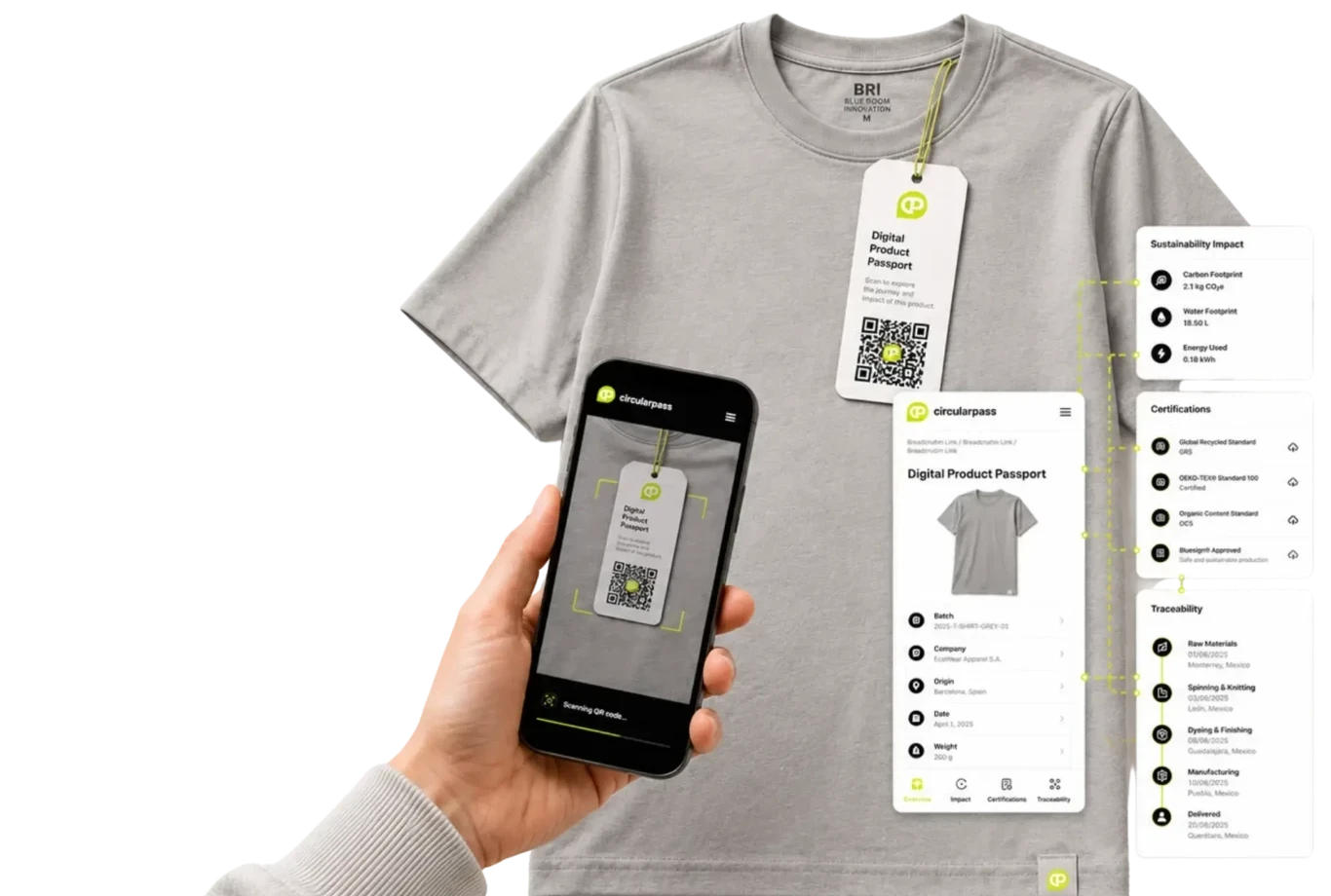

ARTICLE | 12 Min
Material Passport: the key to a more traceable and circular construction sector
EasyTrack: prepare your Digital Product Passport without starting from scratch
June 04, 2026
In this article
The construction sector is undergoing a major transformation. Sustainability is no longer limited to improving the energy efficiency of buildings or using materials with a lower environmental impact. It is becoming increasingly important to demonstrate, with reliable data, which materials are used, where they come from, what performance they offer, what impact they generate, and what possibilities they provide at the end of their life cycle.
This shift is not only driven by market trends. European regulation is moving towards a model in which construction products must be accompanied by digital, structured, accessible, and verifiable information. A clear example is Regulation (EU) 2024/3110, the new European regulation for construction products, which establishes harmonised rules for the marketing of these products and progressively replaces the previous Regulation (EU) No 305/2011.
This regulation, also known as the Construction Products Regulation or CPR Regulation, promotes a more digital, transparent construction sector aligned with European sustainability goals. One of its main developments is the introduction of the Digital Product Passport for construction products, a system designed to facilitate access to technical, environmental, and compliance-related product information.
The regulation entered into force on 7 January 2025, and most of its provisions will apply from 8 January 2026, although its deployment will be gradual and will depend, in part, on new harmonised standards and specific requirements by product family.
In this context, the material passport becomes a strategic tool for manufacturers, construction companies, developers, and waste managers. Although the regulation focuses mainly on the Digital Product Passport, much of the data required to comply with this new framework depends directly on material information: composition, origin, recycled content, environmental impact, traceability, recyclability, and technical documentation.
That is why the material passport should not be understood as just another document. It is a digital foundation that makes it possible to organise material information, improve traceability, and prepare companies for a market where data will be as important as the physical product itself.
What is a material passport?
A material passport is a digital record that collects, organises, and maintains relevant information about the materials used in a product, building, infrastructure, or construction process. Its purpose is to create a digital identity for materials so they can be identified, traced, assessed, and managed throughout their entire life cycle.
Unlike a traditional technical data sheet, a material passport is not limited to describing the characteristics of a product at the time of sale. Its function is broader: it connects information about origin, composition, technical performance, environmental impact, certifications, maintenance, reuse, recyclability, and end-of-life management.
In other words, a material passport helps answer questions such as: which materials are part of a product, where they come from, what their composition is, whether they include recycled content, what environmental impact they generate, whether they can be reused or recycled, and what technical or environmental documentation supports them.
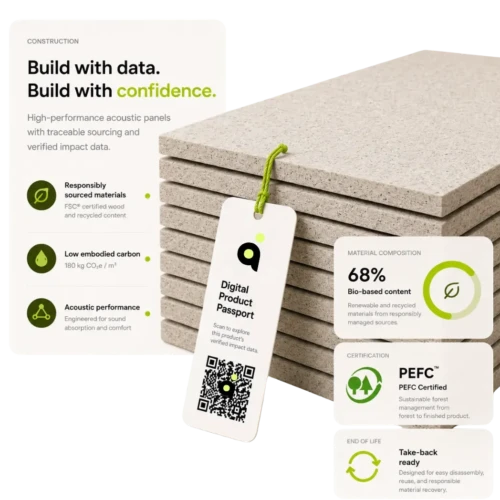
This information is especially important in construction, where materials remain integrated into buildings and infrastructure for decades. A building may contain steel, concrete, wood, glass, aluminium, insulation, flooring, panels, cables, cladding, and many technical components. Without proper traceability, much of this information is lost over time.
When a building is renovated, refurbished, or demolished, many materials are treated as low-value waste simply because their composition, origin, or condition is not precisely known. However, if those materials have a digital passport, they can retain their identity and become valuable resources for new production cycles.
The material passport enables the transition from a linear logic to a circular one. Instead of manufacturing, using, and discarding, it allows materials to be identified, maintained, recovered, and valorised. This difference is essential for building a more resource-efficient economy.
It is also important to understand that a material passport does not have to be the same for every company. Its content may vary depending on the type of product, the level of detail required, the sector, the supply chain, and the company’s objectives. However, its purpose is always the same: to turn material information into useful, traceable, and actionable data.
Why the material passport is key for construction
The construction sector concentrates a large quantity of materials that, once installed, may remain inside buildings and infrastructure for decades. However, the information associated with those materials is not always preserved with the same level of accuracy. Data on composition, origin, certifications, environmental impact, or recovery potential is often spread across different documents, companies, and project phases.
This lack of continuity creates an important problem: when a material loses its information, it also loses part of its value. It becomes more difficult to prove its quality, justify its compliance, plan its maintenance, or recover it properly at the end of its life cycle.
The material passport addresses this challenge by creating a digital identity for each material or construction product. In this way, information is no longer limited to a technical sheet or an isolated certificate, but can accompany the material throughout its entire journey: from manufacturing to installation, use, refurbishment, dismantling, or recycling.
In practice, this allows better decisions to be made at every stage of a project. During design, it helps select materials with more complete data on performance, environmental impact, recycled content, or circularity potential. During construction, it facilitates the traceability of installed products and improves document control. During the building’s use phase, it can support maintenance, replacement, or renovation tasks. And at end of life, it helps identify which materials can be reused, recycled, or recovered with greater guarantees.
The material passport also responds to an increasingly important need for companies in the sector: proving claims with data. In a market where regulatory requirements, ESG criteria, and demands from clients and public administrations are increasing, having structured information about materials can become a competitive advantage.
For this reason, its importance goes beyond sustainability. The material passport helps reduce information loss, improve traceability, facilitate regulatory compliance, and prepare the sector for a more circular, digital, and efficient construction model.
What information does a material passport include?
A material passport can include different levels of information depending on its intended use. However, to be truly useful, it should include technical, environmental, circular, and documentary data.
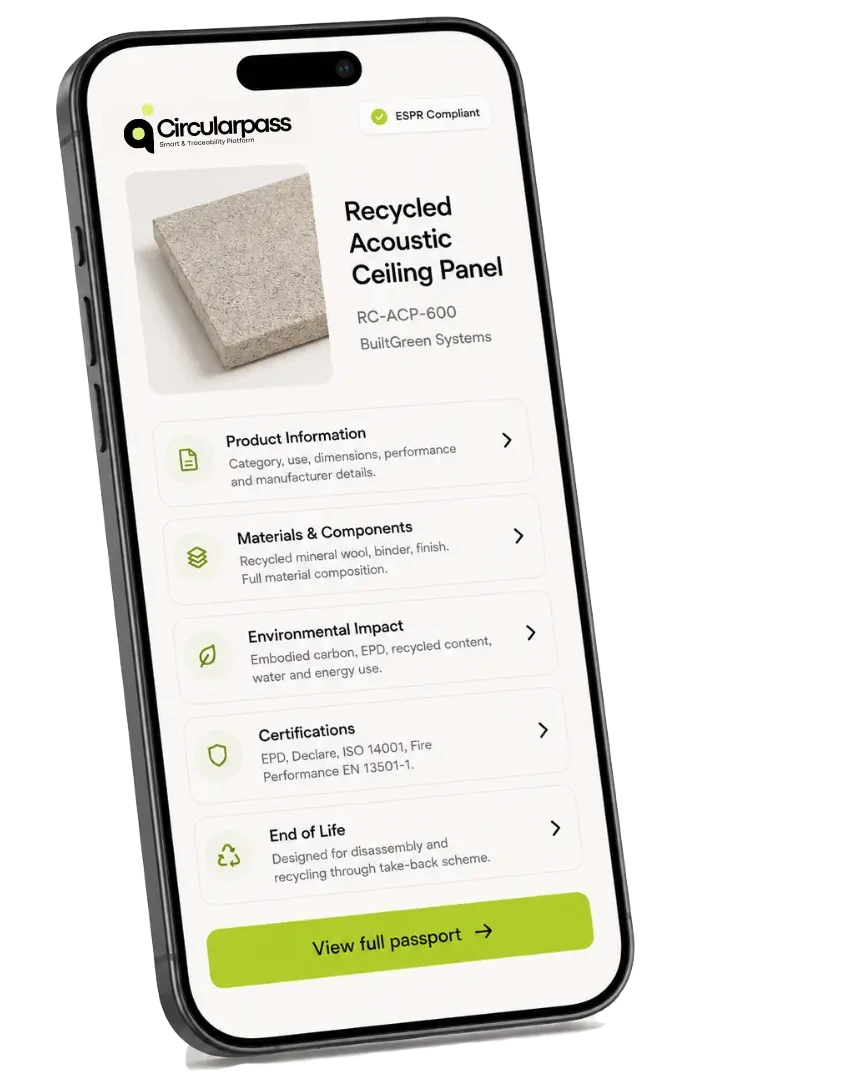
- Material Identification: Basic data linking the physical material to its digital record (name, manufacturer, supplier, batch, production date, reference code, location, product family, unique identifier).
- Composition: Details of the material’s components, such as raw materials, percentages, recycled content, additives, treatments, or coatings, useful for assessing recyclability, safety, and compatibility.
- Technical Performance: Properties and tests related to strength, durability, safety, thermal/acoustic insulation, stability, and mechanical performance, including usage conditions and installation instructions.
- Environmental Information: Indicators such as carbon footprint, energy and water consumption, associated emissions, life cycle assessments, environmental declarations, and certifications.
- Circular Information: End-of-life considerations, including reuse potential, recyclability, dismantling instructions, repair options, valorization, or return to the manufacturer.
- Compliance Documentation: Certifications, CE marking, declarations of conformity, manuals, warranties, and any evidence demonstrating regulatory compliance.
- Material History: Record of events throughout its life cycle: manufacturing, transport, delivery, installation, maintenance, repair, dismantling, reuse, or recycling.
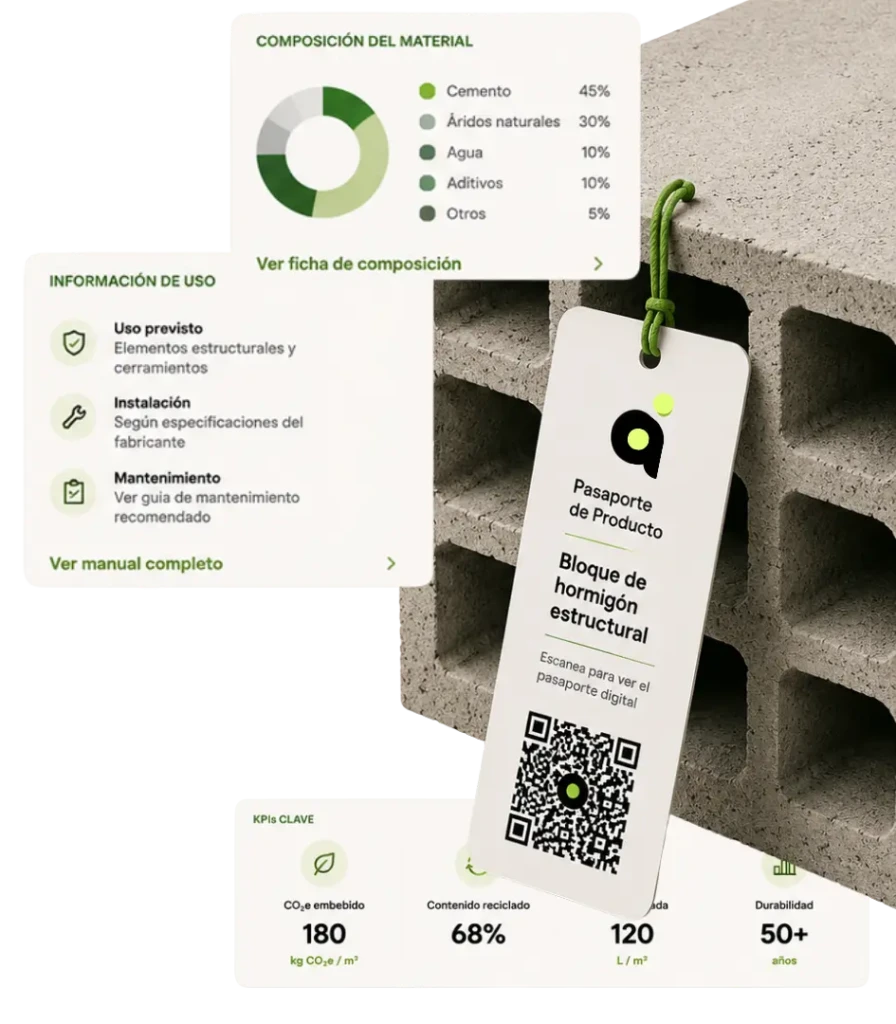
This last point is especially important. A material passport should not be a static snapshot of the product, but a living record. Its value increases when it can be updated and accompany the material throughout its entire life cycle.
The key is for data to be structured, verifiable, and interoperable. It is not simply about uploading documents to a platform, but about turning information into a digital asset that can be consulted, shared, and used to make decisions.
Benefits for manufacturers, construction companies, and waste managers
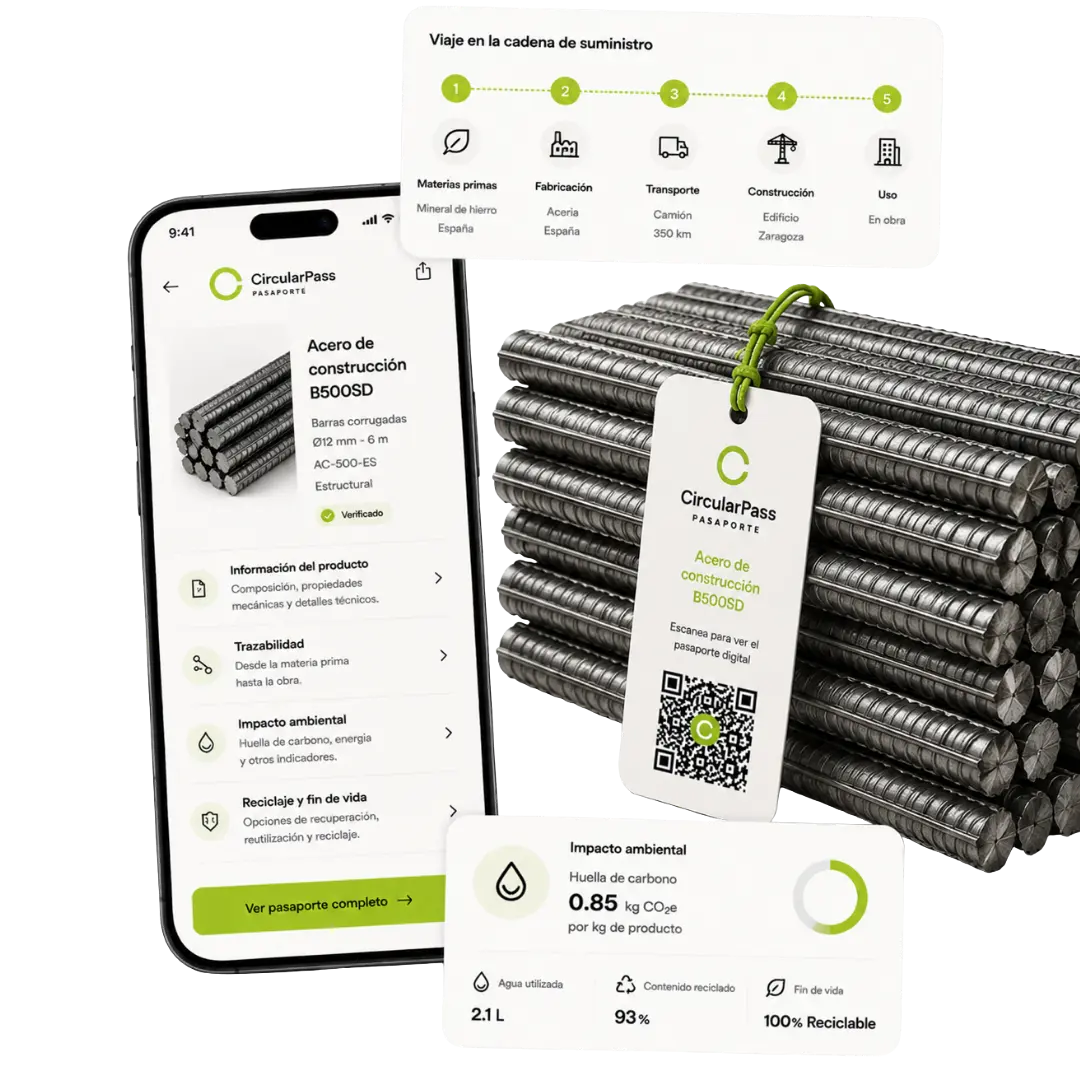
The material passport adds value across the entire construction value chain, from manufacturing to end-of-life management. Its information helps improve processes, ensure compliance, and create value at every project stage.
For manufacturers, it allows them to demonstrate the sustainability and quality of their products with verifiable data, differentiate from competitors, facilitate audits, respond better to tenders, and improve internal supply chain management.
For construction companies, it centralizes on-site information, improves document control, reduces administrative time, and enhances traceability and compliance with environmental and certification requirements.
For developers, it provides transparency and supports maintenance, future refurbishments, and audits. For architects and engineering firms, it enables data-driven decisions regarding cost, technical performance, environmental impact, and circularity of materials.
For waste managers and recyclers, it improves material separation, classification, and valorization, enhancing recycling quality and generating higher-value secondary raw materials.
Overall, the material passport goes beyond regulatory compliance, increasing efficiency, reducing risks, enhancing transparency, and opening new business opportunities.
How to start implementing a material passport with EasyTrack
Implementing a material passport does not have to begin with a complex project or a major technological integration. For many companies, the first step is to organise the information they already have about their products and materials, identify missing data, and create a first functional version of the passport.
EasyTrack, CircularPass’ solution, is designed precisely for this starting point. It enables companies to begin their journey towards the material passport in a guided, practical, and scalable way.
Through EasyTrack, a company can select a product, a family of materials, or a specific line and turn its existing information into a first digital structure. This makes it possible to visualise how the passport would work, what data is needed, and what improvements should be made to move towards more complete traceability.
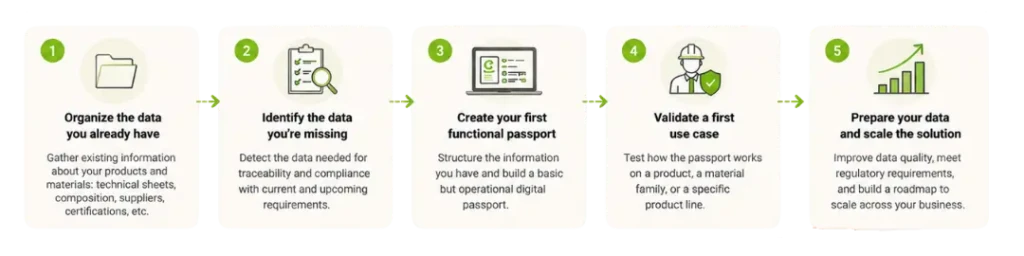
The value of EasyTrack lies in the fact that companies can start without having to digitise their entire catalogue from day one. They can validate a first use case, prepare their data for future regulatory requirements, and build a clear roadmap to scale the solution.
In this way, the material passport stops being an abstract idea and becomes a concrete, manageable, and results-oriented first project.
Practical applications of the material passport
The material passport becomes valuable when it moves from being a digital record to becoming an operational tool. Its usefulness is especially clear when information can be shared among different actors in the value chain in a secure, interoperable, and traceable way.
At Blue Room Innovation, we have worked on projects that demonstrate how digital passports can be applied in real construction-sector contexts, connecting materials, products, waste, and data spaces. This experience allows us to understand the material passport not only as a documentation tool, but as a digital infrastructure to drive the circular economy.
One example is our participation in RETECH, where we developed a data connector to link digital passports associated with waste to a federated data space. The objective was to facilitate the circular traceability of materials and waste generated on construction sites, enabling information to be shared among different ecosystem actors in a controlled and interoperable way.
This approach makes it possible to record relevant information about construction waste, such as its origin, composition, traceability, environmental impact, or valorisation potential. In this way, waste is no longer managed as an opaque flow and is instead treated as a resource with associated information. This supports more sustainable decisions, such as prioritising reuse, improving classification, optimising recycling, or calculating environmental indicators such as carbon footprint.
Another relevant case is Digital Nexus, an initiative in which we worked alongside i2CAT Foundation and Celsa Group to connect CircularPass with European data spaces. In this project, we validated how digital passports can exchange information between organisations in a secure, standardised, and interoperable way.
This connection is essential for the future of construction. A manufacturer, construction company, recycler, or public administration may need access to information about the same material, but not all actors should see the same data or have the same level of permissions. Data spaces make it possible to share information while maintaining each actor’s sovereignty over its own data, enabling collaboration without compromising sensitive information.
Our experience in these projects shows that the material passport is not only a documentation tool or a response to regulatory obligations. It is a digital infrastructure that connects materials, products, waste, and organisations within the same information ecosystem.
When digital passports are integrated with interoperable connectors and data spaces, traceability no longer depends on isolated documents; it becomes part of a verifiable information network. This opens the door to stronger circular economy models, where materials can remain identified, recover value, and re-enter new production cycles with greater confidence.
Ultimately, the practical applications of the material passport show that its true potential lies in connecting data, actors, and decisions. At Blue Room Innovation, we work to make this traceability applicable in real environments, helping companies comply better, collaborate better, and move towards more circular construction.
Related articles
February 2, 2026
Ecodesign Regulation for Sustainable Products (ESPR): what it requires and how to prepare for 2026
An overview of the ESPR Regulation, its requirements, implementation timeline and what companies need to prepare for 2026.
January 20, 2026
The Digital Product Passport in 2026: a key enabler for traceability and sustainability in Europe
What the Digital Product Passport is, why it becomes essential in 2026, and how companies can prepare for Europe’s new traceability standard.

February 11, 2026
Digital Product Passport for textiles: a revolution in the fashion industry
Discover how the digital product passport for textiles is revolutionizing the fashion industry by providing full traceability, sustainability, and transparency.
Start your journey to supply chain transparency today
Discover Blue Room Innovation, the tech company powering CircularPass, where digital solutions meet environmental impact to build a smarter, more circular future.