
ARTICLE | 8 min
Digital Battery Passport under the EU Battery Regulation: requirements and how to prepare for 2027
September 14, 2026
En aquest article
El Digital Battery Passport will be one of the main regulatory developments affecting manufacturers, importers and other companies operating within the European battery value chain.
This obligation forms part of the EU Battery Regulation, Regulation (EU) 2023/1542 concerning batteries and waste batteries. The Regulation establishes a framework covering the entire battery lifecycle and introduces requirements related to sustainability, safety, labelling, performance, durability, recycled content, information and waste management.
The change is significant because compliance is no longer limited to certain physical or technical characteristics at the time a battery is marketed. The information associated with the product also becomes essential: it must be identifiable, structured, available and, where necessary, updated throughout the battery’s lifecycle.
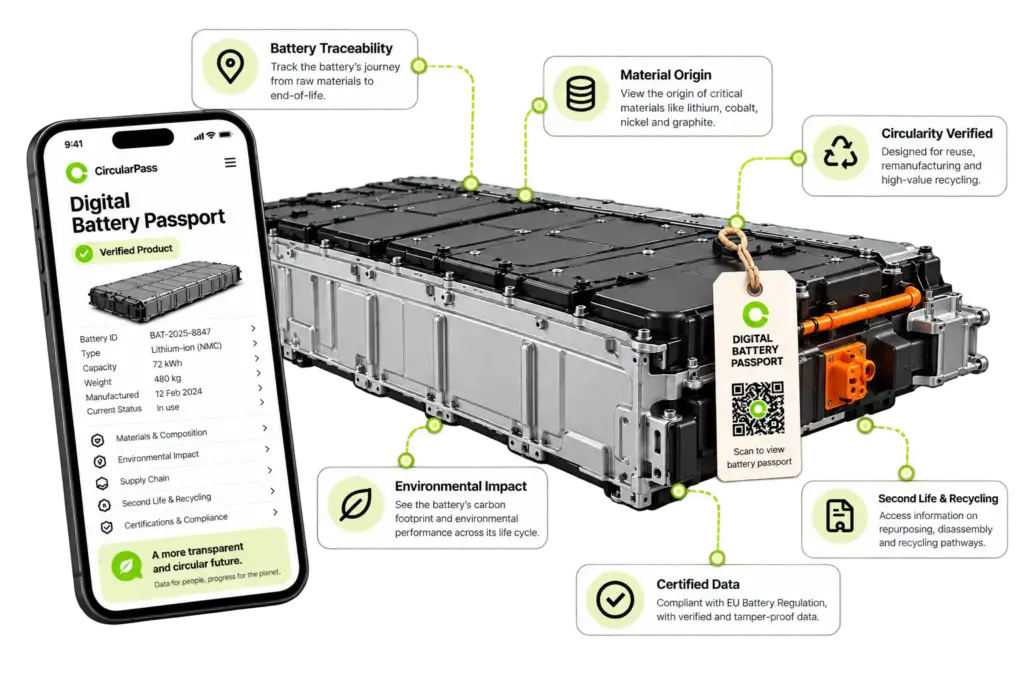
For this reason, the battery passport should not be understood simply as a QR code attached to the product. The QR code will provide access to a much broader digital infrastructure. For companies, the real challenge will be ensuring that the information linked to each battery is reliable, properly structured and accessible to the appropriate users according to their access rights.
From 18 February 2027, certain batteries placed on the EU market or put into service will be required to have an electronic record containing information about their identification, characteristics, composition, sustainability, performance and lifecycle.
What is a Digital Battery Passport and why is it important?
A digital battery passport is an electronic record linked to a battery that connects the physical product with relevant digital information. Under the EU Battery Regulation, the legal term used is “battery passport”, while expressions such as digital battery passport are commonly used to describe the wider digital system behind it.
One of its most important characteristics is that it does not contain information only about a particular battery model. Article 77 of the Regulation establishes that the passport must include information relating to the battery model as well as information specific to the individual battery, including certain data resulting from its use. This means that while some information remains unchanged from the time of manufacture, other data may evolve throughout the product’s lifecycle.
The need for this system becomes clearer when we consider the complexity of the battery value chain. Battery production may involve raw material suppliers, component and cell manufacturers, module producers, battery assemblers and finished battery manufacturers. Later stages may involve vehicle manufacturers, service providers, repair companies, reuse operators and recyclers. Information about materials, technical characteristics and performance can therefore be distributed across many different organisations.
The purpose of the battery passport is to make certain relevant information available throughout the product lifecycle. This data can be used to support regulatory compliance, product assessment and activities such as maintenance, repair, reuse and recycling. In this sense, the passport provides a digital link between the different stages of a battery’s life.
What does the EU Battery Regulation require?
El EU Battery Regulation, officially Regulation (EU) 2023/1542 concerning batteries and waste batteries, provides the main legal framework for the digital battery passport. It regulates batteries from a lifecycle perspective, establishing requirements that begin with manufacturing and placing on the market and continue through to the management of waste batteries.
The Regulation addresses areas such as sustainability, safety, labelling, product information, performance, durability, recycled content and waste management. Within this wider framework, Articles 77 and 78 specifically govern the battery passport, while Annex XIII sets out the categories of information that must be included.
Article 77 covers key elements such as the types of batteries subject to the passport requirement, the information that must be included, access rights, responsibility for the data and the relationship between the QR code and the unique identifier. Article 78 focuses on the technical design and operation of the system, including requirements relating to authentication, reliability, integrity, security and data availability.
The EU Battery Regulation is also connected to Regulation (EU) 2024/1781 on ecodesign requirements for sustainable products, which establishes the broader framework for the European Digital Product Passport. Batteries have their own sector-specific rules, but the battery passport operates within this wider European digital product information infrastructure.
Important — The battery passport is only one element of the EU Battery Regulation. A company should avoid treating the implementation of the battery passport as equivalent to full compliance with the Regulation.
When will the battery passport become mandatory and which batteries are affected?
The key date is 18 February 2027. From that date, batteries falling within the scope of Article 77 must have a battery passport when they are placed on the EU market or put into service.
The requirement applies mainly to three categories.
Electric vehicle batteries
Batteries designed primarily to provide traction for electric vehicles.
Light means of transport batteries
Batteries used in electric bicycles and other light electric vehicles covered by the Regulation.
Industrial batteries >2 kWh
Particularly relevant to companies in energy storage and industrial applications, including certain stationary battery systems.
However, the arrival of 2027 does not mean that every battery sold in Europe will automatically require a digital passport. Small consumer batteries and other categories are not necessarily covered by this specific obligation. Companies need to examine how each product is classified under the Regulation.
The timing also requires careful attention. The Regulation refers to batteries being “placed on the market or put into service” from the relevant date. This means that the manufacturing date alone does not necessarily determine whether the passport requirement applies.
For companies holding inventory, importing products from outside the EU or operating long supply chains, the distinction may be particularly important. Determining when a product is legally considered to have been placed on the market can affect whether a battery falls within the 2027 requirement.
For this reason, one of the first practical steps should be to review the company’s battery portfolio and classify products according to the categories established in the Regulation. This makes it possible to determine which batteries require passports and to define the actual scale of the implementation project.
How will the digital battery passport work?
One of the most visible elements of the system will be the QR code attached to the battery. Its purpose is to provide access to the digital passport and connect the physical product with a unique identifier assigned to it. The QR code itself does not contain the entire passport. Instead, it acts as the link between the battery and its digital identity. When a user accesses the passport, the system will identify the relevant battery and display the information that the user is authorised to see.
The Regulation also introduces technical requirements designed to prevent each company from developing a completely isolated system. Battery passport information must be based on open standards, stored in interoperable formats, machine-readable, structured and searchable. The system must support data exchange rather than relying entirely on proprietary formats or manual processes.
This interoperability is particularly important because the information required for the passport may come from many different systems. Technical product data might be stored in engineering platforms, commercial information in enterprise systems, environmental information in sustainability tools and material data in supplier databases.
A digital battery passport solution must therefore be capable of bringing these different sources together and connecting the correct information to the correct battery.
There are also requirements relating to authentication, reliability, data integrity, security and privacy. The system must ensure that information remains protected and that access is granted according to the rights established by the Regulation.
The wider European infrastructure has also advanced significantly. In 2026, the EU Digital Product Passport Registry became operational, creating part of the common infrastructure needed for the new system. Standards have also been developed to support areas such as unique identifiers, interoperability, data carriers, application interfaces and data exchange.
For businesses, selecting a technology provider should not be based only on how the final passport looks to the user. The more important questions concern how the platform connects to existing systems, manages access rights, supports future updates and complies with European interoperability requirements.
What information must the battery passport contain?
The content of the battery passport is likely to be one of the most demanding aspects of implementation. Annex XIII of the EU Battery Regulation sets out different categories of information covering identification, composition, sustainability, performance, durability and circularity.
Not every data point applies in the same way to every type of battery, so companies will need to determine which information is relevant to each product category.
Battery identification
Information to identify the battery model, manufacturer and individual product. The unique identifier connects the physical battery to its digital record.
Materials and composition
Battery chemistry, material composition, hazardous substances and critical raw materials. More detailed data may be accessible for repair, dismantling or recycling.
Sustainability
Where applicable, information on carbon footprint, recycled content and other environmental requirements established under the Regulation.
Performance and durability
Rated capacity, voltage, power, expected lifetime, energy efficiency and other technical parameters depending on battery category.
State of health
Data relating to the battery's condition or status that may change over time — relevant for reuse, repurposing or recycling decisions.
Circularity information
Information supporting dismantling, repair, reuse, repurposing, remanufacturing and recycling activities across the battery lifecycle.
In August 2026, the European Commission published additional guidance to support companies preparing for the battery passport. The guidance identifies 71 data points and indicates, depending on the battery category, whether each one is mandatory, optional, conditionally applicable or not yet required at the start of the passport obligation.
For companies, this creates a useful framework for carrying out a data gap analysis. The first question should not be which software platform to purchase, but which required data already exists, where it is stored and which information still needs to be obtained.
This analysis can reveal gaps that are not primarily technological. A business may have a sophisticated digital infrastructure and still struggle to comply if suppliers cannot provide the necessary information or if data is inconsistent across different internal systems.
How should companies prepare for the digital battery passport in 2027?
Companies should start by identifying which batteries fall within the scope of the EU Battery Regulation and determining which products will require a digital battery passport from 18 February 2027.
The next step is to review the required data and identify where it is stored, who is responsible for it and which information must be obtained from suppliers. This helps reveal data gaps before technology decisions are made.
Companies should then ensure that their systems can connect the relevant information to each battery identifier, manage different access rights and support updates where necessary. Supplier coordination and clear internal responsibilities will also be essential.
Finally, it is advisable to test the process with a limited number of battery models before the deadline. A pilot project can help identify missing data, integration issues or unclear responsibilities before the passport becomes mandatory.
EASYTRACK BY CIRCULARPASS
Start your battery passport preparation now
CircularPass helps companies map their product data, identify gaps and build the infrastructure needed for compliant Digital Product Passports — including the battery passport.
Talk to our teamArticles relacionats

2 de febrer de 2026
Reglament d'ecodisseny per a productes sostenibles (ESPR): què requereix i com preparar-se per al 2026
Una visió general del Reglament ESPR, els seus requisits, el calendari d'implementació i el que les empreses han de preparar per al 2026.

20 de gener de 2026
El Passaport Digital de Producte al 2026: un factor clau per a la traçabilitat i la sostenibilitat a Europa
Què és el Passaport Digital de Producte, per què esdevé essencial el 2026 i com les empreses es poden preparar per al nou estàndard de traçabilitat d'Europa.

11 de febrer de 2026
Passaport de producte digital per a tèxtils: una revolució en la indústria de la moda
Descobreix com el passaport digital de producte per a tèxtils està revolucionant la indústria de la moda proporcionant traçabilitat, sostenibilitat i transparència totals.
Comença avui mateix el teu viatge cap a la transparència de la cadena de subministrament
Descobreix Blue Room Innovation, l'empresa tecnològica que impulsa CircularPass, on les solucions digitals es combinen amb l'impacte ambiental per construir un futur més intel·ligent i circular.