
ARTICLE | 7 Min
The Digital Product Passport in 2026: a key enabler for traceability and sustainability in Europe
Ecodesign Regulation for Sustainable Products (ESPR): what it requires and how to prepare for 2026
February 2nd, 2026
In this article
The European Union has begun a profound transformation in the way products are designed, manufactured and placed on the market. The Ecodesign for Sustainable Products Regulation (ESPR) is one of the key pillars of this new regulatory framework and will define the rules of the European market from 2026 onwards.
This regulation does not emerge in isolation. It is part of a broader strategy driven by the European Union to move towards a more sustainable, transparent and circular economic model, aligned with initiatives such as the European Green Deal and the Circular Economy Action Plan. In this context, sustainability ceases to be a value-add and becomes a structural requirement of the market.
A new European framework for product ecodesign
The Ecodesign for Sustainable Products Regulation, commonly referred to as ESPR, significantly expands the traditional concept of ecodesign. Until now, European regulation had focused mainly on the energy efficiency of certain products. With the ESPR, the scope broadens to consider the overall environmental impact of products throughout their entire life cycle.
This means assessing how products are designed, which materials they use, how long they last, whether they can be repaired or upgraded, and what happens when they reach the end of their life. Ecodesign is no longer a narrow technical requirement but a cross-cutting principle that influences decisions related to design, manufacturing, logistics and information management.
This shift responds to a clear need: to reduce pressure on natural resources, minimise waste and improve transparency in the European market. For companies, it represents a move away from reactive compliance towards a more strategic view of products as long-term assets.
Who the regulation affects and why it matters now
The ESPR applies to all companies placing physical products on the European Union market, regardless of whether they are established within or outside the EU. Manufacturers, importers and distributors will need to progressively adapt to the new requirements if they wish to continue operating in Europe.
The regulation’s scope is broad and deliberately flexible. Implementation will take place through delegated acts specific to each product category, prioritising sectors with the highest environmental impact. Industries such as textiles, electronics, iron and steel, aluminium, construction and batteries are among the first to be affected, but the intention is to extend the framework to most physical products in the coming years.
The current moment is particularly important because the specific requirements are being defined now. The decisions companies make at this stage, regarding internal processes, product data management and information digitalisation, will determine how easily they can adapt when obligations become fully enforceable from 2026.
What the ESPR really requires from companies
One of the most significant changes introduced by the Ecodesign Regulation is that compliance is no longer limited to isolated technical characteristics of a product. The ESPR defines a set of attributes that, taken together, determine whether a product can be considered sustainable within the European framework.
In practical terms, this means products will need to consume fewer resources during use, have a longer lifespan and be designed to be repaired, disassembled and reused more easily. The presence of substances that hinder circularity must be reduced, while material recyclability becomes a central criterion.
In addition, a key requirement comes into play: the availability of reliable and accessible information. Companies must be able to provide clear data on product composition, materials used, environmental impact, repair options and end-of-life management. This information is no longer internal or static; it becomes part of a data ecosystem that accompanies the product over time.
In this context, product traceability and the traceability of associated information become structural elements of regulatory compliance, rather than optional improvements.
The Digital Product Passport as a key element of compliance
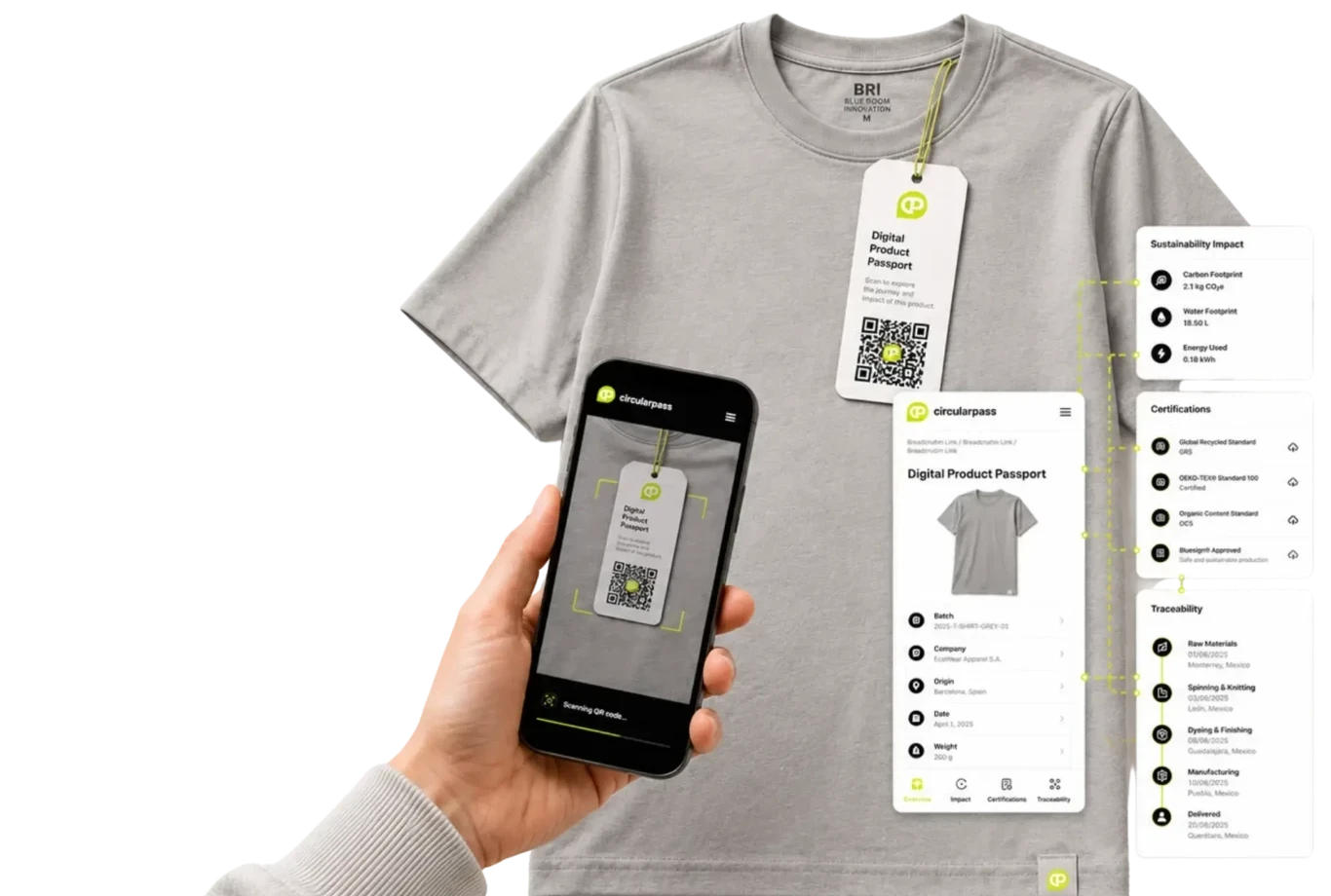
Although the Ecodesign Regulation does not introduce the Digital Product Passport as a standalone obligation, it does establish the framework that makes its adoption necessary. The Digital Product Passport emerges as the mechanism that allows information required by the ESPR to be structured, maintained and shared consistently throughout the product’s life cycle.
Through this approach, information is no longer scattered across documents, internal systems or disconnected databases. Instead, it becomes part of a single digital structure that is accessible and updatable. This not only facilitates regulatory compliance, but also improves operational efficiency and communication between different actors in the value chain.
Furthermore, the Digital Product Passport aligns with other regulatory measures evolving alongside the ESPR, such as restrictions on the destruction of unsold goods or strengthened sustainability criteria in public procurement. In many cases, having such a solution in place will allow companies to meet multiple regulatory obligations simultaneously.
If you would like to explore what a Digital Product Passport is and how it works in more detail, you can read our dedicated article on the DPP.
Preparing for 2026: from regulatory obligation to competitive advantage
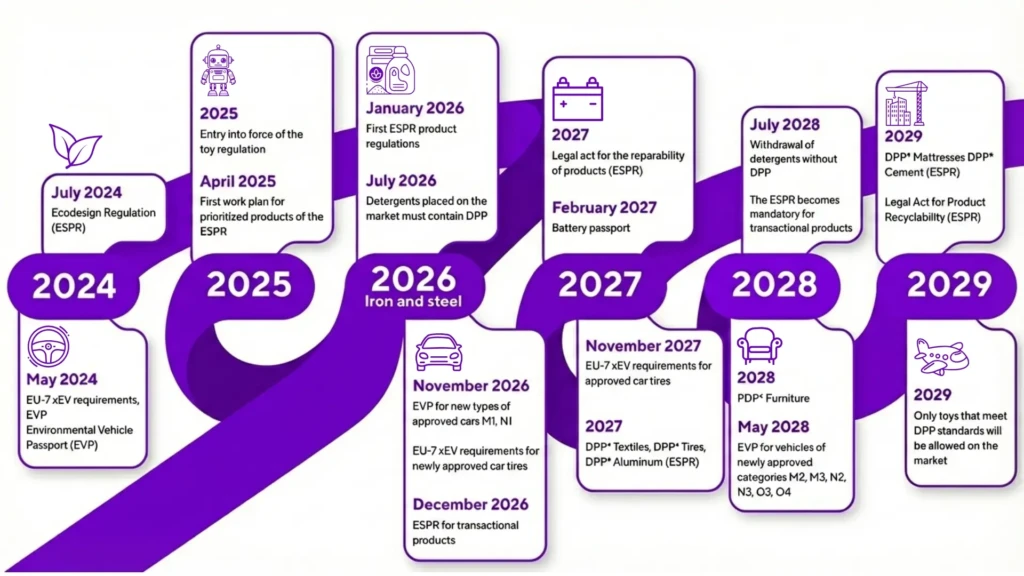
The roadmap for the implementation of the ESPR is already defined. As the timeline shows, the regulation will be rolled out progressively between 2024 and 2029, with specific requirements entering into force at different moments depending on the product category and sector. While this phased approach gives companies some room to adapt, it also makes one thing clear: the transition has already started.
Waiting until requirements become mandatory for a specific product category may seem reasonable, but in practice it often leads to rushed decisions, higher implementation costs and limited strategic flexibility. Many of the obligations introduced by the ESPR, particularly those related to product information, traceability and transparency, require changes that cannot be implemented overnight.
Preparing for 2026 therefore means looking beyond individual deadlines and understanding the broader trajectory set by the regulation. Companies that start early can progressively align their internal processes, data structures and digital infrastructure with the upcoming requirements, rather than reacting to them under time pressure.
More importantly, early preparation allows organisations to treat the ESPR not merely as a compliance exercise, but as an opportunity. By structuring product information, improving traceability and adopting digital tools such as the Digital Product Passport, companies can increase operational efficiency, strengthen trust across the value chain and position themselves ahead of competitors who delay action.
The Ecodesign for Sustainable Products Regulation is not just a new legal framework. It is a clear signal of the direction in which the European market is moving, and a reminder that those who anticipate regulatory change are better placed to turn compliance into long-term competitive advantage.
Related articles

January 20, 2026
The Digital Product Passport in 2026: a key enabler for traceability and sustainability in Europe
What the Digital Product Passport is, why it becomes essential in 2026, and how companies can prepare for Europe’s new traceability standard.

February 11, 2026
Digital Product Passport for textiles: a revolution in the fashion industry
Discover how the digital product passport for textiles is revolutionizing the fashion industry by providing full traceability, sustainability, and transparency.

May 12, 2026
EasyTrack: prepare your Digital Product Passport without starting from scratch
Discover how EasyTrack helps your company prepare its Digital Product Passport with a guided pilot, structured data, and a functional prototype.
Start your journey to supply chain transparency today
Discover Blue Room Innovation, the tech company powering CircularPass, where digital solutions meet environmental impact to build a smarter, more circular future.